What this is
Citadel is a city builder where the land is real listed companies. You stake tokenised shares on Robinhood Chain; each holding becomes a plot that produces every second; you spend the output raising towers and walls; and anything you leave unwalled, another player can march on and carry off.
Your shares never leave your control. The vault holds them and gives them back in kind — deposit NVDA, withdraw NVDA. It does not sell, swap or route anything. What is at risk in a raid is the output you have not claimed and a capped slice of the stake, never the position itself.
The loop, in four moves
- Stake. Put tokenised shares behind an industry. Minimum $25 per holding. Output is proportional to the value staked — nothing else produces anything.
- Produce. A staked plot mints SCRIP continuously, awake or not, at 70 SCRIP per dollar per epoch before multipliers. Raw materials come with it.
- Build. Cover enough of an industry and you may raise it a level. Each level adds 25% to everything that industry produces, and burns SCRIP plus the materials of every earlier era.
- Raid. March on another city, break a front, carry its unclaimed production home. That is real income, not a scoreboard.
The numbers that shape everything
Two currencies, and they are not interchangeable
Keeping these apart is the single most useful thing to understand before playing.
| SCRIP | CDLT | |
|---|---|---|
| What it is | The city's own currency | A tradeable token |
| Where it comes from | Produced by your staked plots | Bought on the open market |
| What it does | Builds towers, mans walls, funds raids | Staked for a production boost, and governance |
| Can you sell it | No — it has no market and no redemption | Yes |
| Can it be taken | Yes, unclaimed output is raid loot | No, staking it is never at risk from a raid |
SCRIP is scrip in the strict sense: a private currency good only inside the town that issued it. It is minted by production, burned by building, and escrowed by raiding. Withdrawing from the vault returns your shares, never SCRIP. More on SCRIP and on CDLT.
The five eras
Industries open one at a time, and the order is not a suggestion — the chain refuses a build in an industry past your frontier. Reaching level 1 in your frontier industry advances it.
| Era | Industry | Subs | Companies | Material |
|---|---|---|---|---|
| I | Information Technology | 11 | 37 | Silicon |
| II | Consumer Discretionary | 4 | 6 | Bandwidth |
| III | Communication Services | 3 | 7 | Iron |
| IV | Industrials | 4 | 8 | Dollar |
| V | Financials | 2 | 3 | Bond |
Each level in an industry burns the material of every industry before it, so an early district never goes idle — it becomes the supply line for the next one.
The board, in full
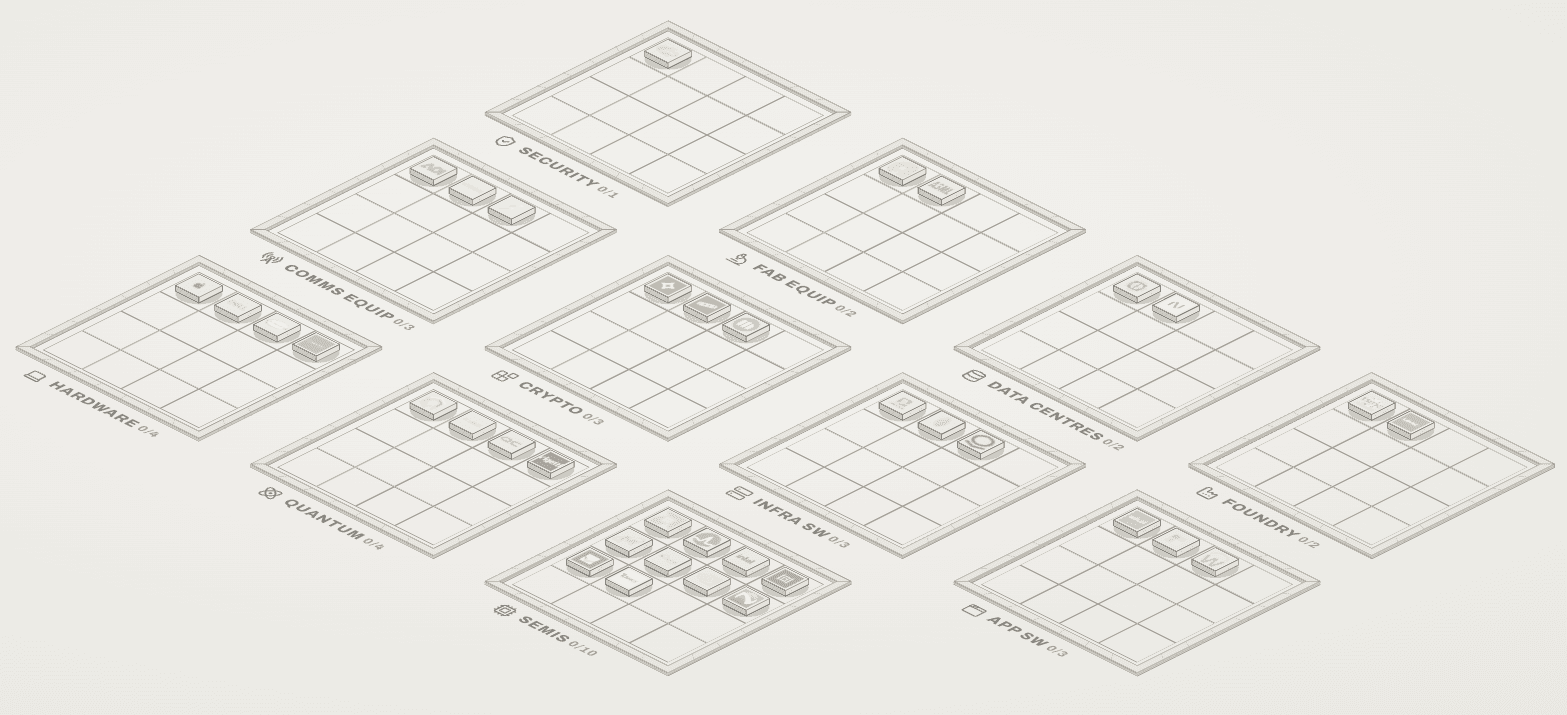
Sixty-one listed companies. Each one is a plot: stake its tokenised shares and that plot starts producing.


If you are about to play for the first time, start with your first hour. If you want the arithmetic, go straight to production. Every parameter is listed on one page, and the contract addresses are here too.