Your first hour
Nothing below assumes you have played anything like this before. There is one order that works, it is not obvious from the screen, and it takes about an hour.
What you are looking at
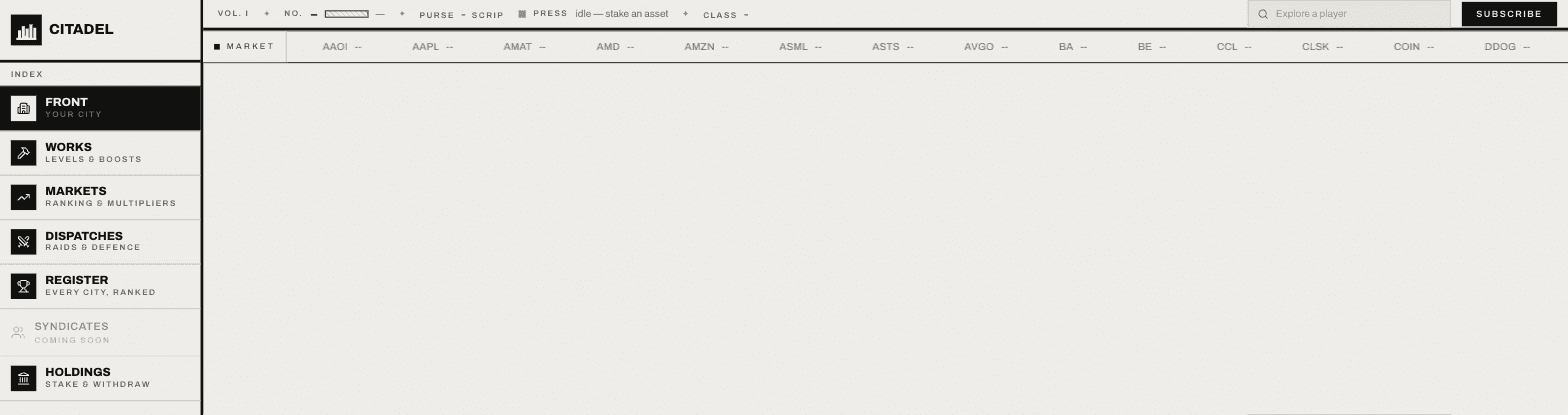
The prices read
-- here and the city below is blank because this capture has no wallet connected — which is worth seeing, because it is the state you arrive in. Every figure in the app is read from the chain for your address, so until you connect there is nothing to read.Subscribe, top right, is the connect button. Every screen needs a wallet, because every figure on them is read from the chain for your address.
Reading the board
This is the front page: one industry, filling the screen. Each raised square is a plot, and each plot is a listed company. Each framed platform is a sub-industry.
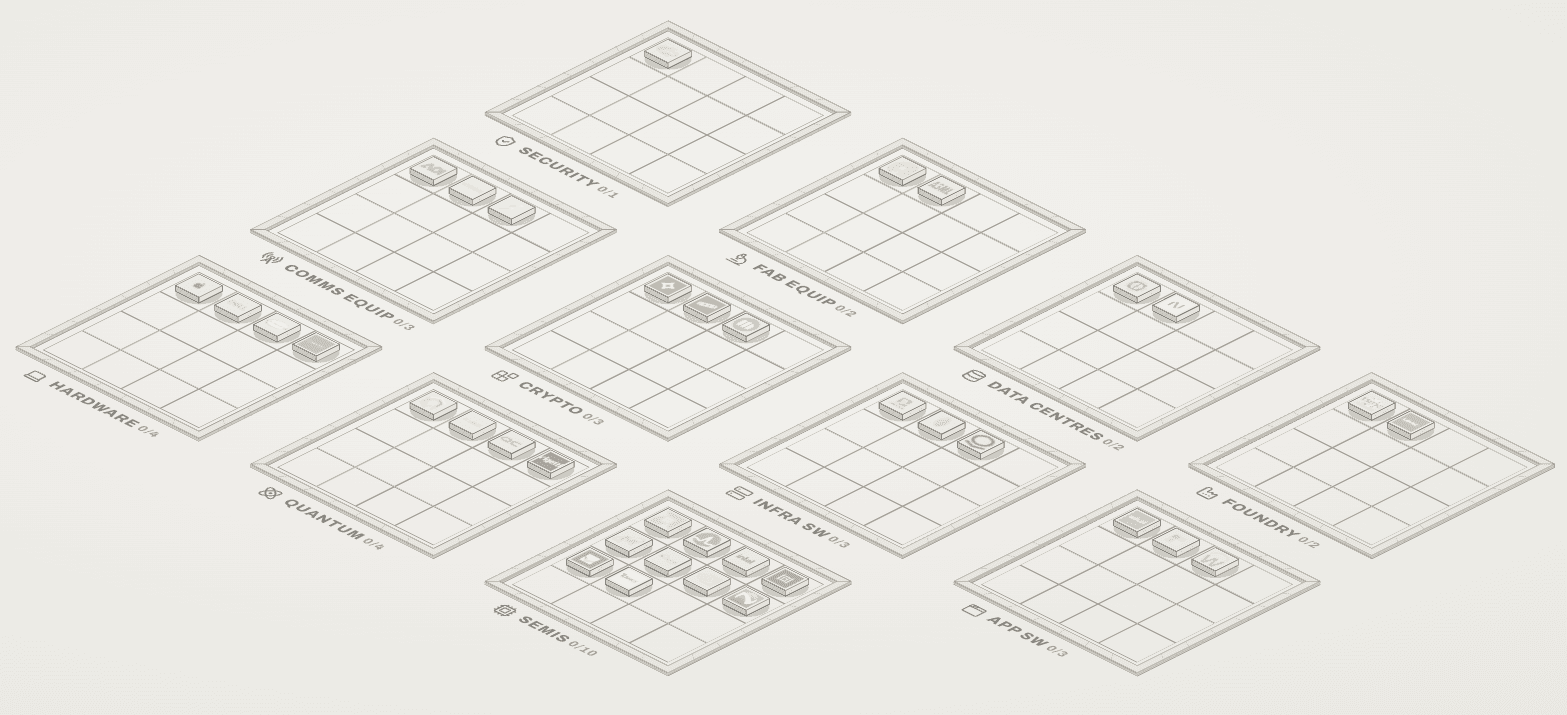
SEMIS 0/10 means ten semiconductor companies exist and you hold none of them.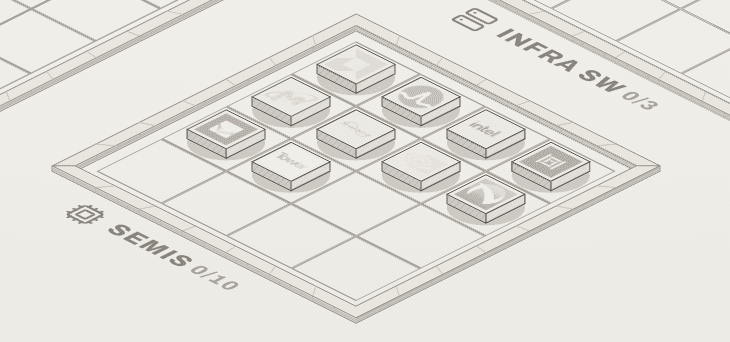
- A grey slab — a company on the board that you do not hold.
- A lit tower with a glowing edge — one you hold, and it is producing right now.
- The badge names the sub-industry and counts your coverage of it.
- A dot on a badge marks a sole supplier: one company, no substitute. Holding it is the only way to cover that sub-industry.
The order that works
- 1Connect, and go to Holdings
Holdingsin the index is where shares go in and come out. Deposit is direct and withdrawal is in kind: put in NVDA, take out NVDA. The vault does not sell, swap or route anything. - 2Stake into Information TechnologyIt is the only industry the chain will let you build in first — the others are locked until you have built here. Minimum $25 per company; below that the position still produces but does not count toward coverage.
- 3Spread across sub-industries, do not concentrateThis is the rule that decides everything and the one beginners get wrong. Building is gated on how many different sub-industries you hold, not on how much money you put in. Ten semiconductor names cover one sub-industry. One company from each of four different ones covers four, which is what a full upgrade needs.
- 4Watch the store, and claimYour plots produce continuously. The store holds 3 days of your own output and anything past that is spilled for good — it does not queue. There is a 4 hours cooldown between claims.
- 5Build one levelOnce you cover 4 sub-industries, build. The first level costs 100 SCRIP and takes 4 hours. It adds 25% to what that plot produces — and reaching level 1 here is what unlocks the next industry.
- 6Put something on a wall before you growYou are immune for your first 4 epochs, but only while your portfolio is under $1,000. SCRIP committed to a front is a wall. There are six fronts and everyone can see which ones you paid for.
The four mistakes that cost the most
- Concentrating in one sub-industry. Ten semiconductor names produce well and cannot build at all. Coverage is a count, not a sum.
- Letting the store fill. Past 3 days the output is gone, not queued. A full store is both wasted production and the largest prize you can offer a raider.
- Crossing $1,000 with no walls. New-account immunity has a value ceiling and crossing it is silent. This is the most common way a first city gets emptied.
- Assuming a raid is instant. An attack on you is visible for 8 hours before it lands — time to claim and reinforce. But walls freeze 15 minutes before impact, so do not leave it to the last minute.
A worked example
Say you stake $1,000 across four different sub-industries at $250 each. That is above the $25 minimum on every position, so all four count, and you have the coverage a full upgrade needs. At a neutral 1.00x you produce 70,000 SCRIP a week — the first level costs 100, so the first build is a matter of minutes, not days.
What to read next
Production · Coverage & building · Walls & shields · The three ladders